A Complete Guide to the AA Big Book

If you have ever looked into or attended an AA meeting, you may have heard of The Big Book. The Big Book of AA is a text used in Alcoholics Anonymous to spread the word of how to recover from alcoholism and share the AA recovery stories of others. The book is over 400 pages and can be broken down into 2 overarching parts. The first is dedicated to explaining how the program works and using anecdotes for an explanation. Included are chapters targetted towards certain groups of people, as well as how the 12 steps, 12 traditional, and 9 promises tie in. The other part of the book is dedicated to recovery stories. This 2nd part has changed from one edition to the other to include more recent stories that are more relatable to members in recovery today.

It was actually written by the first 100 members of AA. However, a man named William G. Wilson, aka Bill W., took on the bulk of the project and is credited as the author. He began wroke on the text in 1938 and the first edition was published on April 10, 1939. Over the years the book has been republished with new stories of recovery, without changes to the sections discussing the recovery program itself. There are 4 editions of the AA Big Book, with the most recent edition having been published just in 2001. 

The Big Book Across the Globe

Alcoholics Anonymous began in New York and didn’t really take off to become the widely trusted program we know today. However, this 12 step recovery program did eventually spread across the world. Today, the big book is one of the most all-time sold books with over 30million copies sold. In fact, The AA Big Book has been translated into 67 different languages and used by members in over 170 countries.

Big Book AA Acronyms

There are countless acronyms used in the AA community. A few of these are specifically related to The Big Book. In fact, if you see “BB”, this is the direct acronym for “Big Book”. It may be used to reference the text or to indicate that a particular AA meeting will be focused on the Big Book text. 

What happens at a Big Book Meeting?

Although all AA meetings generally start and end the same, the bulk of the meeting may vary. During a Big Book meeting, the leader will likely read a passage of The Big Book to the group and discuss the reading, what it means to them, and how it relates to recovery. During some meetings, they may open the discussion to other members present.

Search our AA meeting directory to find an AA Big Book meeting near you.

What is Big Book Study AA? 

Depending on the context, if you see “Big Book Study AA” it may be an AA meeting or a reference to a Big Book Study Guide for Alcoholics Anonymous. There are multiple groups that have published study guides designed to help members understand the contents of the Big Book. However, these are not published by Alcoholics Anonymous World Services. 

How Much is an AA Big Book?

If you are in the market for an AA Big Book, you have a few options. Of course, you can purchase a book off of Amazon, but this may not be the best option for you. There are ways to get the text for free as well as digital options. Consider all of your options before making a purchase, especially if money is tight.

A Hand-Me-Down Book

Step 12 of AA states “Having had a spiritual awakening as the result of these steps, we tried to carry this message to alcoholics, and to practice these principles in all our affairs.” As a part of this step, AA members are encouraged to pass on their books and other materials to other members who may need it more. This is one way in which they carry the message of the program to alcoholics. If you do not have the means to purchase a Big Book, you can likely get one with the help of a local chapter. 

Purchase a Book

The Big Book can also be purchased new or used. Depending on where you purchase your book, the price can vary. They can be purchase from the following locations:

Related Posts

Life Beyond the Steps: Alternative Support Systems for Recovery (SMART, Dharma, Refuge)
If you’ve tried A.A. but found it did not resonate with you, …
What is the Mindfulness-Oriented Recovery Enhancement (MORE) method?
What if you could gain 20 years of insight and advice from …
The Importance of Remote Alcohol Monitoring
In the journey of addiction recovery, maintaining sobriety is a daily challenge. …
50 Self-Compassion Recovery Quotes to Heal, Grow, and Thrive
Self-compassion is a powerful tool in recovery, whether you’re healing from addiction, …
Top 10 Non-Alcoholic Beverage Companies
The non-alcoholic beverage industry has exploded in recent years, offering more than …
The 12 Principles of AA
Alcoholics Anonymous (AA) is a global community of individuals who have struggled …
7 Tips on How to Host the Ultimate Sober Friendsgiving
The holiday season can be challenging for those on the path to …
Court Ordered Alcohol Monitoring Bracelets: What You Should Know
Alcohol monitoring bracelets are an increasingly common punishment for DUI arrests as …
Can you get a DUI on a Bike?
The law is very clear about the consequences of being intoxicated while …

Does AA work for everyone?

Asking “does AA work for everyone?” is like asking if everyone has the same fingerprint. Of course not! Every human is unique in their biology, how they were raised, and how they react to medications, therapies, and certain situations. Similarly to how you can never know for sure if someone will struggle with addiction until they do, you will never know if AA will work for someone until they try it. 

The Success of Alcoholics Anonymous

How many people does AA work for? Although we know AA will not be the answer for every single individual who struggles with alcoholism, we do know that it helps some people. Additionally, measuring success is not black and white. Is success 1 year sober, 5 years sober, or a lifetime of sobriety? Moreover, can we say the program is successful if someone attends meetings for the first year or so of their sobriety and then stops attending meetings but still maintains their sobriety?

Self-reported Statistics on AA

In 2014, Alcoholics Anonymous conducted a survey of its members. Members were not required to participate, and the survey ended up with approximately 6,000 participants. One question on the survey asked how long the member had been sober1. The results were as follows:

  • 27% – Less Than 1 Year
  • 42% – Between 1 and 5 Years
  • 13% – Between 5 and 10 Years
  • 14% – Between 10 and 20 Years
  • 22% – Over 20 years

In the Big Book, the program also claims a 50% success rate and that 25% remain sober after some relapses.

Outside Studies on Alcoholics Anonymous

In addition to the surveys and statistics provided by AA, outside groups have preformed studies to try and provide an unbiased understanding of the program’s success. One study was published under the Alcohol Research Current Reviews (ARCR). This was a long-term study that looked at individuals who received formal treatment, informal treatment (AA), and no treatment at all. The study followed up with these individuals after 1 year, 3 years, and 8 years following their initial sobriety. The results were as follows:

  • Of the participants who entered AA on their own, half were still sober after 1 year and 3 years, but a fourth of the participants had maintained their sobriety as of the 8-year follow up.
  • 46% of individuals who had formal treatment and 49% who attended AA meetings were sober at the 8-year follow-up.
  • For some, attending AA meetings was associated with long-term sobriety, but not for all.

Although these were limited studies, they do show that some success is seen with 12 Step programs, but it is not a perfect solution for all. Also, studies have shown that formal treatment and AA meetings together provide better success than one of these programs on their own.

Limitations of 12 Step Programs

Why does AA not work for everyone? Admittedly, there are some limitations to AA meetings and the 12 Step program. These limitations often receive criticism, but studies more often show that AA helps. With that, take these limitations with a grain of salt. 

Loosely Structured Addiction Support

Although 12 step programming does follow a structure, this structure is not strictly enforced. Individuals groups may adjust the way they operate depending on the individual group’s needs. Although many see this as a benefit, it can also be viewed as a limitation. It leaves lots of room for practices that are not proven or evidence-based. These programs are not usually run by trained professionals and they may say or do something a professional may advise against. This brings me to the 2nd major limitation…

Not Formal or Professional Treatment

From the group leaders to the sponsors, AA meetings are not usually made up of people who have any professional experience or training in addiction treatment. The members and leaders work off of their own personal experiences with addiction. As everyone is different and has their own unique experiences with addiction, one cannot necessarily apply their experience and what worked for them to others. Some argue that the lack of formal training could be detrimental, or even dangerous.

Alternatives to AA

There are alternatives to Alcoholics Anonymous for those who do not feel that the program is for them. In addition to traditional 12 Step programs, there are alternatives for people who are not religious. 

  • AA Agnostics is a group for people who may be spiritual but do not believe in God in for traditional fashion.
  • Formal Addiction Treatment Programs provide a variety of treatment programs from residential treatment to outpatient treatment. Although some do incorporate the 12 steps as a part of their treatment programming, not all do. Others have non-12 step programming and group meetings.
  • SMART Recovery is another alternative approach to addiction treatment which many turn to when 12 step programs do not work for them.

At Find Recovery, we know that the answer to “Does AA work for everyone?” is “No”. We also know that AA does work for many. This is a part of why we hope to provide struggling addicts with as many resources as possible. Our goal is to, you guessed it: help you Find Recovery. Check out our directory of Treatment Centers and AA meetings near you to find the recovery path right for you!

Related Posts

Life Beyond the Steps: Alternative Support Systems for Recovery (SMART, Dharma, Refuge)
If you’ve tried A.A. but found it did not resonate with you, …
What is the Mindfulness-Oriented Recovery Enhancement (MORE) method?
What if you could gain 20 years of insight and advice from …
The Importance of Remote Alcohol Monitoring
In the journey of addiction recovery, maintaining sobriety is a daily challenge. …
50 Self-Compassion Recovery Quotes to Heal, Grow, and Thrive
Self-compassion is a powerful tool in recovery, whether you’re healing from addiction, …
Top 10 Non-Alcoholic Beverage Companies
The non-alcoholic beverage industry has exploded in recent years, offering more than …
The 12 Principles of AA
Alcoholics Anonymous (AA) is a global community of individuals who have struggled …
7 Tips on How to Host the Ultimate Sober Friendsgiving
The holiday season can be challenging for those on the path to …
Court Ordered Alcohol Monitoring Bracelets: What You Should Know
Alcohol monitoring bracelets are an increasingly common punishment for DUI arrests as …
Can you get a DUI on a Bike?
The law is very clear about the consequences of being intoxicated while …

What do they say at the beginning and end of AA meetings?

An overview of a typical AA meeting structure.

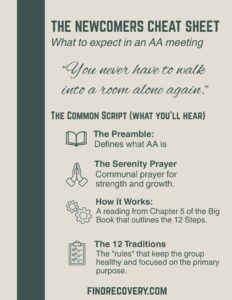
Newcomer’s Tip: You are never forced to speak, pray, or stand up. It is perfectly okay to sit quietly and listen. If someone asks you to read or speak and you don’t want to, a simple “I’m just here to listen today” is always respected.

Businessmen do research on their prospects before sitting down to pitch them. Parents research neighborhood crime rates and school ratings before moving into a new home. Some people simply like to be prepared, and there is nothing wrong with that. Even those who struggle with addiction like to know what they are getting into when attending an AA meeting. The following breakdown of an AA meeting’s structure will help provide insight to those who are new to Alcoholics Anonymous.

AA Meeting Structure

When it comes to the beginning and ending, most AA meetings follow the same general structure. However, each meeting is individually run and may differ slightly based on the group’s specific needs and interests. For instance, an AA Agnostics group may not say all of the prayers that are usually recited. As a reference point, the following elements make up a typical AA meeting:

  1. AA Preamble
  2. Moment of Silence
  3. Serenity Prayer
  4. Newcomers Intro
  5. “How It Works” readings
  6. Meeting Sharing & Discussion
  7. 7th Tradition Contribution
  8. Closing Prayer

What do they say at the beginning of AA meetings?

The very first thing that is recited at a typical Alcoholics Anonymous meeting is the AA Preamble. The Preamble is a short reading that states what AA is, what its purpose is, and what the requirements are.

AA Preamble:

ALCOHOLICS ANONYMOUS is a fellowship of men and women who share their experience, strength and hope with each other that they may solve their common problem and help others to recover from alcoholism. The only requirement for membership is a desire to stop drinking. There are no dues or fees for A.A. membership; we are self-supporting through our own contributions. A.A. is not allied with any sect, denomination, politics, organization or institution; does not wish to engage in any controversy; neither endorses nor opposes any causes. Our primary purpose is to stay sober and help other alcoholics to achieve sobriety.

Although the AA Preamble is the first thing they say at the beginning of AA Meetings, there are a few other things said before they get to the topic of the meeting. After a moment of silence, the Serenity Prayer is recited, typically as a group:

Serenity Prayer

God, grant me the Serenity to accept the things I cannot change, Courage to change the things I can, and Wisdom to know the difference. 

Living one day at a time, Enjoying one moment at a time, Accepting hardship as a pathway to peace, Taking, as Jesus did, This sinful world as it is, Not as I would have it, Trusting that You will make all things right, If I surrender to Your will, So that I may be reasonably happy in this life, And supremely happy with You forever in the next.

Amen.

Next, the leader will ask if there are any newcomers. The newcomers are given an opportunity to introduce themselves, and in some cases, all members partake in introductions. This is not a time to share a long story, but to tell the group your name. It is not required, but the individuals may identify themselves as addicts if they so choose. In some instances, the members also share their sobriety date.

As the last element before beginning the meeting topic, a “How It Works” reading may be recited.

What Happens in the Middle of the Meeting (the Sharing Part)?

While the beginning and end of a meeting provide a familiar structure, the “middle” is where the actual work of recovery happens. This is the Sharing and Discussion portion, typically lasting 40 to 60 minutes. If you are a newcomer, this is often the part that feels most intimidating, but it is actually designed to be a safe, judgment-free zone.

The “No Cross-Talk” Rule

The most important thing to understand about the middle of the meeting is the “No Cross-Talk” policy. In AA, we do not interrupt, ask questions, or offer direct advice to someone while they are sharing. We speak only from our own “experience, strength, and hope.” This ensures that every person can speak their truth without fear of being corrected or judged.

How to Share

When the chairperson opens the floor, members will indicate they want to speak (often by raising a hand or simply waiting for a silence). A typical share follows a simple format:

  • The Introduction: “Hi, my name is [Name], and I’m an alcoholic.”

  • The Content: Most members talk about “what it was like, what happened, and what it is like now.” They might discuss the meeting topic or something they are currently struggling with.

  • The Time Limit: To ensure everyone has a chance to speak, most meetings suggest keeping shares to 3–5 minutes.

  • The Conclusion: Most people end by saying “Thank you” or “I’ll pass the remains of my time,” signaling that the next person can speak.

Do I Have to Speak?

No. If the chairperson calls on you and you aren’t ready to talk, you can simply say, “I’m just here to listen today, thank you.” No one will pressure you to say more. In many meetings, the leader will say, “We will now have a period of quiet sharing,” meaning the floor is open to anyone who feels moved to speak.

Topics and Themes

Depending on the meeting type, the “middle” might focus on:

  • Step Study: Reading and discussing a specific step.

  • Big Book Study: Reading a paragraph from the basic text and sharing how it applies to life today.

  • Speaker Meeting: One person tells their full story for 20–30 minutes, followed by brief comments from the group.

What do they say at the end of an AA Meeting?

After the sharing and discussion part of an AA meeting is completed, there are just a few things done to close out the meeting. The first is the 7th Tradition collection, and the last is a closing prayer. 

The 7th tradition states, “Every A.A. group ought to be fully self-supporting, declining outside contributions.” This means that it is the member’s own contributions that fund the meetings. This includes purchasing any chips, materials, and refreshments provided during the meetings. No one is required to contribute. In fact, many groups suggest that first-timers refrain from contributing. 

The closing prayer is typically the “Our Father Prayer”:

Our Father, Who Art in Heaven,
Hallowed be Thy Name.
Thy Kingdom come, Thy Will be done
On earth as it is in Heaven.
Give us this day our daily bread,
And forgive us our trespasses,
As we forgive those who trespass
against us.
Lead us not into temptation,
But deliver us from evil,
For Thine is the Kingdom, and the Power,
and the Glory Forever and ever.

Amen.

Once this prayer is completed, the meeting is concluded, and the members disperse. They may grab a snack to go, stay and talk with other members for a little while, or leave and go about their business.

Practical Application for Newcomers: If you’re nervous, arrive 5 minutes late and sit near the back. You’ll see that the “Preamble” and “How It Works” act like a familiar ritual that helps everyone settle in. Don’t worry about memorizing the prayers; most groups provide printed cards or have them on the wall.

Discussion Starters for the Group

If you are leading the meeting, use these discussion starters to move beyond the “ritual” of the readings and into real-world application. These questions are designed to help both newcomers and long-timers examine how the structure of the meeting—from the Preamble to the final prayer—actually supports their daily sobriety and shapes their connection to the fellowship.

  • “What was your first impression of the AA Preamble? Did it make you feel welcome or confused?”

  • “Which of the ‘How It Works’ suggestions was the hardest for you to accept at first?”

  • “The closing prayer often signifies a transition back to the ‘outside world.’ How do you take the spirit of the meeting with you when you leave?”

Frequently Asked Questions

Q: Do I have to stand up during the prayers?

A: Most people stand and hold hands, but it is not a requirement. If you are uncomfortable, you can remain seated.

Q: What is a “Moment of Silence”?

A: It is a few seconds at the start of the meeting to remember the “addict who is still suffering.”

Q: Why do they say “Hi, [Name]” after someone introduces themselves?

A: It is a way of showing the newcomer they have been heard and are part of the group.

Related Posts

Life Beyond the Steps: Alternative Support Systems for Recovery (SMART, Dharma, Refuge)
If you’ve tried A.A. but found it did not resonate with you, …
What is the Mindfulness-Oriented Recovery Enhancement (MORE) method?
What if you could gain 20 years of insight and advice from …
The Importance of Remote Alcohol Monitoring
In the journey of addiction recovery, maintaining sobriety is a daily challenge. …
50 Self-Compassion Recovery Quotes to Heal, Grow, and Thrive
Self-compassion is a powerful tool in recovery, whether you’re healing from addiction, …
Top 10 Non-Alcoholic Beverage Companies
The non-alcoholic beverage industry has exploded in recent years, offering more than …
The 12 Principles of AA
Alcoholics Anonymous (AA) is a global community of individuals who have struggled …
7 Tips on How to Host the Ultimate Sober Friendsgiving
The holiday season can be challenging for those on the path to …
Court Ordered Alcohol Monitoring Bracelets: What You Should Know
Alcohol monitoring bracelets are an increasingly common punishment for DUI arrests as …
Can you get a DUI on a Bike?
The law is very clear about the consequences of being intoxicated while …

How Do I Get an AA Chip?

Members who join Alcoholics Anonymous are working every day to maintain their sobriety and to live a better life. It is a day by day process and it is not easy. Those who maintain sobriety should be proud of their accomplishment. However, many need a reminder of what they are doing and how far they have come. For many, an AA chip fills this role. However, newcomers might beg the question “How do I get an AA chip?” From the milestones to the actual process of receiving the chip, there is more to know then you may think.

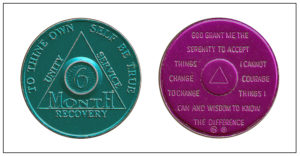
AA Chips are earned by members of alcoholics anonymous who achieve certain time periods of sobriety. These are recognized by members as a reminder of their personal length of sobriety or of the achievement they have made. These chips start with a newcomer picking up a chip for 24 hours of sobriety all the way to veteran memberships that have been sober for decades through the program of alcoholics anonymous. The following is a specific timeline that is used to distribute these chips and to mark each milestone and what the coins look like.

    1. Silver Chip – 24 hours of sobriety
    2. Red Chip – 30 days/1 month of sobriety
    3. Gold Chip – 60 days/2 months of sobriety
    4. Green Chip – 90 days/3 months of sobriety
    5. Purple Chip – 4 months of sobriety
    6. Pink Chip – 5 months of sobriety
    7. Dark Blue Chip – 6 months of sobriety
    8. Copper Chip – 7 months of sobriety
    9. Red Chip – 8 months of sobriety
    10. Purple Chip – 9 months of sobriety
    11. Gold Chip – 10 months of sobriety
    12. Green Chip – 11 months of sobriety
    13. Bronze Chip – 1 year of sobriety.

After 1 year sober, chips are given out yearly. This means members get a chip at 1 year sober, 2 years sober, 3 years sober, and so on. These milestones are generally the ones recognized in all AA groups, but some groups provide chips for additional milestones. They may be every month for the first year, or even longer. 8-month and 18-month chips are not unheard of. It is really up to the individual chapter to provide these chips at the milestones they choose.

Receiving my AA Chip

In order to receive an AA chip, you must attend AA meetings. At these meetings, members are encouraged to share that they have reached a milestone, and the group leader will present them with the appropriate chip.

Unless you are on parole, there is no one following you and making sure that you aren’t drinking or drugging. It is up to the individual to be honest about their substance use. If you relapse, you are asked to turn in your chips and to start back at day 1. If you lie about this, you are only hurting yourself. The group cannot provide proper support if you aren’t’ honest, and the chips mean nothing if they are representing real milestones achieved.

Related Posts

Life Beyond the Steps: Alternative Support Systems for Recovery (SMART, Dharma, Refuge)
If you’ve tried A.A. but found it did not resonate with you, …
What is the Mindfulness-Oriented Recovery Enhancement (MORE) method?
What if you could gain 20 years of insight and advice from …
The Importance of Remote Alcohol Monitoring
In the journey of addiction recovery, maintaining sobriety is a daily challenge. …
50 Self-Compassion Recovery Quotes to Heal, Grow, and Thrive
Self-compassion is a powerful tool in recovery, whether you’re healing from addiction, …
Top 10 Non-Alcoholic Beverage Companies
The non-alcoholic beverage industry has exploded in recent years, offering more than …
The 12 Principles of AA
Alcoholics Anonymous (AA) is a global community of individuals who have struggled …
7 Tips on How to Host the Ultimate Sober Friendsgiving
The holiday season can be challenging for those on the path to …
Court Ordered Alcohol Monitoring Bracelets: What You Should Know
Alcohol monitoring bracelets are an increasingly common punishment for DUI arrests as …
Can you get a DUI on a Bike?
The law is very clear about the consequences of being intoxicated while …

What Women Should Know About Alcoholics Anonymous

Alcoholics Anonymous is a program that is designed to be applicable to people of all ages, gender, race, nationality, religion, etc. However, there can sometimes be a tremendous benefit to meetings that are focused on one particular group of people. This is especially true for gender. Generally speaking, women face different challenges in life and with addiction than men do. This is what you should know if you are a woman who is recovering from alcohol addiction and looking to Alcoholics Anonymous.

Benefits of A Women’s AA Meeting

Generally speaking, women face a whole set of societal pressures and expectations that men may not also experience. Women are also more likely to struggle with alcohol due to a relationship with a man and they are more likely to avoid treatment due to judgment or fear that they may face losing their children.

Women’s AA meetings…

  • allow more time to be dedicated to talking about issues most common among women who are alcoholics.
  • create a unique opportunity for women to tell stories that their fellow women are more likely to be able to relate to.
  • foster a space where women can talk about issues and stories that they may not be comfortable sharing among men.

What does “AA Woman” mean?

When looking for an aa meeting near you, there are a number of different acronyms used to identify what type of meeting it is and who is invited to attend. If you are looking for a women-only AA meeting, look at the tags to identify if it is a women’s meeting. The potential tags to identify these meetings are “Women” or “W”. 

Are Trans Women Welcome to Women’s AA Meetings?

Many LGBTQ+ alcoholics feel quite comfortable in any A.A. group. However, there are many unique issues that those who identify as a part of the LGBTQ+ community face. To provide a safe space for these individuals, there are also meetings that are organized specifically for the LBGTQ+ community. 

When looking for a meeting, some of the tags you may find to help you identify these meetings include: 

  • Gay, 
  • LGBTQ, 
  • Lesbian.

Find a Woman’s AA Meeting

Related Posts

Life Beyond the Steps: Alternative Support Systems for Recovery (SMART, Dharma, Refuge)
If you’ve tried A.A. but found it did not resonate with you, …
What is the Mindfulness-Oriented Recovery Enhancement (MORE) method?
What if you could gain 20 years of insight and advice from …
The Importance of Remote Alcohol Monitoring
In the journey of addiction recovery, maintaining sobriety is a daily challenge. …
50 Self-Compassion Recovery Quotes to Heal, Grow, and Thrive
Self-compassion is a powerful tool in recovery, whether you’re healing from addiction, …
Top 10 Non-Alcoholic Beverage Companies
The non-alcoholic beverage industry has exploded in recent years, offering more than …
The 12 Principles of AA
Alcoholics Anonymous (AA) is a global community of individuals who have struggled …
7 Tips on How to Host the Ultimate Sober Friendsgiving
The holiday season can be challenging for those on the path to …
Court Ordered Alcohol Monitoring Bracelets: What You Should Know
Alcohol monitoring bracelets are an increasingly common punishment for DUI arrests as …
Can you get a DUI on a Bike?
The law is very clear about the consequences of being intoxicated while …

10 Sober Activities to Keep You Busy & Sober Throughout The Coronavirus

For individuals in recovery, a routine is important. The recommendations to stay home, practice social distancing, and basically avoid other people where possible can be frustrating and lonely. Social isolation means avoiding group support meetings in addition to other potential changes in one’s day-to-day life. Maybe you are not able to go to work, school, or family gatherings. Although it could be tempting to drink or use drugs while you sit at home, look at this newly found free time in a new light. How many times have you thought “if there were only a little more time in the day?” Any extra time you have is time that you can spend doing all the things that for years you wished you had time to do. 

In case you can’t think of all of the things that you have wanted to do over the years, here are 10 activities that you can do, not only while you are sober, but to help keep you sober. And, no, none of them include Netflix.

1. Read A Book

Is there a book that you have been meaning to read? Now is the perfect time to pick it up. Maybe you were reading a few pages at a time, but now you might actually be able to finish it!

2. Learn A New Skill

Who doesn’t want a new skill? This could be any new skill. Maybe you have been wanting to learn how to knit a sweater, or maybe the skill is to learn how to code. The possibilities are endless! Maybe find an online class, read some articles, or watch a Youtube tutorial to help you along the way.

3. Work on a Business Idea

Many people have an idea for an invention or a business, but simply don’t have the time to create a proper business plan and put it into action. What better time is there than now? This could be the start of a whole new adventure for you, in the best way possible!

4. Clean Your House

Let’s be honest here, at least half of the people who will read this article probably have many chores around the house that need to be done. Fold that laundry! Wash the dishes! Vacuum and mop the floors! You will be surprised how amazing it feels to have a wonderfully clean home. There are no excuses left, the time to clean is now!

5. Perfect a New Recipe

Nutrition plays a huge role in recovery, so why not try and perfect a new recipe. Heck, maybe work through an entire cookbook worth of recipes. This could even be your new skill.

6. Workout

A gym is not necessary to work out. Download some Jillian Michael and get yourself moving! If you have some dumbbells and a yoga matt, then now is the time to take them out. However, all you really need is your own body. Move over the coffee table and stretch in the living room or consider going for a run.

7. Paint a Picture

It doesn’t have to be good, but it could be. Painting is very therapeutic and entertaining. You just might end up with a fun new piece of art to hang on your wall.

8. Start a Blog or Vlog

Individuals in recovery have a lot to offer to those who do not think they are capable of overcoming their addiction. Take your extra time to start a blog or vlog and tell your story. Share what you can and spread words of support and success. 

9. Spend Time Getting To Know Your Roommate or Loved One

If you live with a roommate, family member, or romantic partner, your time and distance from others give you a special opportunity to bond with each other. Talk. Ask questions. Learn something new about one another that you may not have known before. Learn to appreciate each other in a new way. For goodness sake, this is the person you may look back at in 10, 20, 50 years from now as the person you hunkered down with during the Coronavirus outbreak.

10. Work on Your Recovery

Regardless of whether you are in a 12 step program, another recovery program, or not following a specific program at all, this is time that you can spend working on your recovery. Reflect on what you have done and how you are moving forward. Work through your steps. Think about how you will work on rebuilding relationships that may be strained. There is always work to do.


If you are worried about getting supplies for anything listed here, remember that delivery is an option. Just be sure to disinfect anything before you bring it into your home. Maybe you only do one of these activities, maybe you do them all! Just keep your sobriety in focus and keep in contact with your support system. Stay sober and stay safe!

What Does AA Cost?

How much AA costs is a common question that people unfamiliar with the AA program ask. There are no dues or fees to become a member of alcoholics anonymous. Members and traditions state that we can only keep what we have by giving it away. During meetings, a basket is passed amongst the groups to accept donations that cover common costs like rent, literature, AA Chips, or coffee for the group. Alcoholics anonymous has always declined outside contributions while remaining fully self-funded. Donations are appreciated but are not required when attending an AA meeting. The only actual requirement is the desire to live a life free from alcohol and all mood and mind-altering substances. 

Cost of materials (big book) or how to get them free.

The current cost of a Big Book is $5.99. Most of the time a sponsor or an elder group member will pass along an old copy to the new members. Again, following the traditions of alcoholics anonymous you only keep what you have by giving it away. Pamphlets of literature are also provided at meetings. These pamphlets are free for the taking and the only request is that when finished you pass it along to another person in need. Members of alcoholics anonymous believe in a motto of attraction rather than promotion and these types of selfless acts to help others struggling is a great way to spread the message of recovery.  

Do you have to pay for AA chips? 

AA Chips are a tool used by the groups and symbolize lengths of sobriety. These are given away to members to celebrate their length of sobriety. The contributions collected by the group are used to purchase these items and then given to the member that is celebrating and extending the length of time they have maintained sobriety.

AA is a Priceless Commitment

The amount of money that becoming an AA member costs is zero. There is no required cost at all. Regardless of the amount of time spent with meetings and any other commitment, if you are a true alcoholic and this is the road that you choose to remain sober, the money or time spent is more valuable than you can imagine. Giving yourself the opportunity to live a life free from alcohol and truly live is priceless. Sobriety can not be monetized by dollars and cents. The value vs cost of a meeting is simply answered with the question “how much is your life worth to you?” 

How AA is funded?

Since AA was found it has declined any outside funding. The groups have always remained fully self-supported. Their donations are given during meets by members and then the local intergroup decides the best way to spend those funds in accordance with what is best for the local groups. They also will host a variety of events such as picnics, dances, alcotons, or spaghetti dinners, as well as other types of community-friendly events.

What does aa cost? It doesn’t have to cost a dime.

Now that we answered your question of “what does AA cost”? and that it is beyond affordable, get started with this program that is accessible to everyone. Find an AA meeting near you.

Related Posts

Life Beyond the Steps: Alternative Support Systems for Recovery (SMART, Dharma, Refuge)
If you’ve tried A.A. but found it did not resonate with you, …
What is the Mindfulness-Oriented Recovery Enhancement (MORE) method?
What if you could gain 20 years of insight and advice from …
The Importance of Remote Alcohol Monitoring
In the journey of addiction recovery, maintaining sobriety is a daily challenge. …
50 Self-Compassion Recovery Quotes to Heal, Grow, and Thrive
Self-compassion is a powerful tool in recovery, whether you’re healing from addiction, …
Top 10 Non-Alcoholic Beverage Companies
The non-alcoholic beverage industry has exploded in recent years, offering more than …
The 12 Principles of AA
Alcoholics Anonymous (AA) is a global community of individuals who have struggled …
7 Tips on How to Host the Ultimate Sober Friendsgiving
The holiday season can be challenging for those on the path to …
Court Ordered Alcohol Monitoring Bracelets: What You Should Know
Alcohol monitoring bracelets are an increasingly common punishment for DUI arrests as …
Can you get a DUI on a Bike?
The law is very clear about the consequences of being intoxicated while …

What is AA? The Basics of Alcoholics Anonymous

What is AA?

AA, or Alcoholics Anonymous is an international fellowship that meets regularly to help individuals and families who struggle with alcoholism. All individuals who acknowledge they have a drinking problem and have a desire for recovery are welcome at AA meetings. 

As each AA group is self-funded and there are no dues or fees required, those who believe in the program and want to make it accessible for others may dedicate a significant amount of time to doing so. This may include securing 

What is the meaning of AA?

AA stands for Alcoholics Anonymous. Literally speaking, that means that it comprises groups of individuals who have identified as alcoholics and are meeting with an understanding of anonymity. Figuratively speaking, Alcoholics Anonymous often has a slightly different, deeper meaning for its members.

For some, Alcoholics Anonymous is a tool for support to maintain their sobriety but for many others, it is a way of life. The 12 Steps and 12 Traditions of AA lead the decisions and actions in everyday lives of many AA members. Members may see AA as a path to a new life or they may find a new family in their fellow members. Alcoholics Anonymous is truly life-altering for a great number of people.

Click Here to download the 12 Steps of Alcoholics Anonymous

Click Here to download the 12 Traditions of Alcoholics Anonymous

What is the purpose of AA?

The purpose of AA is quite simple, it is to help individuals who struggle with alcoholism to get sober and stay sober. 

What is AA NOT?

  • AA is not for profit.
  • AA is not allied with any group, cause, or religious denomination.
  • AA is not limited to age, gender, social, economic, or cultural backgrounds (although individual meets may be limited in some regards).
  • AA is not an organization was works to recruit members. Members join based on their own choice. 
  • AA is not a medical treatment program.
  • AA is not a cure for addiction. There is no cure for addiction.

Find An AA Meeting Near Me

Related Posts

Life Beyond the Steps: Alternative Support Systems for Recovery (SMART, Dharma, Refuge)
If you’ve tried A.A. but found it did not resonate with you, …
What is the Mindfulness-Oriented Recovery Enhancement (MORE) method?
What if you could gain 20 years of insight and advice from …
The Importance of Remote Alcohol Monitoring
In the journey of addiction recovery, maintaining sobriety is a daily challenge. …
50 Self-Compassion Recovery Quotes to Heal, Grow, and Thrive
Self-compassion is a powerful tool in recovery, whether you’re healing from addiction, …
Top 10 Non-Alcoholic Beverage Companies
The non-alcoholic beverage industry has exploded in recent years, offering more than …
The 12 Principles of AA
Alcoholics Anonymous (AA) is a global community of individuals who have struggled …
7 Tips on How to Host the Ultimate Sober Friendsgiving
The holiday season can be challenging for those on the path to …
Court Ordered Alcohol Monitoring Bracelets: What You Should Know
Alcohol monitoring bracelets are an increasingly common punishment for DUI arrests as …
Can you get a DUI on a Bike?
The law is very clear about the consequences of being intoxicated while …