
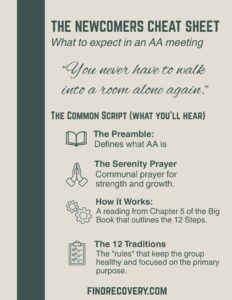
An overview of a typical AA meeting structure.
Newcomer’s Tip: You are never forced to speak, pray, or stand up. It is perfectly okay to sit quietly and listen. If someone asks you to read or speak and you don’t want to, a simple “I’m just here to listen today” is always respected.
Businessmen do research on their prospects before sitting down to pitch them. Parents research neighborhood crime rates and school ratings before moving into a new home. Some people simply like to be prepared, and there is nothing wrong with that. Even those who struggle with addiction like to know what they are getting into when attending an AA meeting. The following breakdown of an AA meeting’s structure will help provide insight to those who are new to Alcoholics Anonymous.
AA Meeting Structure
When it comes to the beginning and ending, most AA meetings follow the same general structure. However, each meeting is individually run and may differ slightly based on the group’s specific needs and interests. For instance, an AA Agnostics group may not say all of the prayers that are usually recited. As a reference point, the following elements make up a typical AA meeting:
- AA Preamble
- Moment of Silence
- Serenity Prayer
- Newcomers Intro
- “How It Works” readings
- Meeting Sharing & Discussion
- 7th Tradition Contribution
- Closing Prayer
What do they say at the beginning of AA meetings?
The very first thing that is recited at a typical Alcoholics Anonymous meeting is the AA Preamble. The Preamble is a short reading that states what AA is, what its purpose is, and what the requirements are.
AA Preamble:
ALCOHOLICS ANONYMOUS is a fellowship of men and women who share their experience, strength and hope with each other that they may solve their common problem and help others to recover from alcoholism. The only requirement for membership is a desire to stop drinking. There are no dues or fees for A.A. membership; we are self-supporting through our own contributions. A.A. is not allied with any sect, denomination, politics, organization or institution; does not wish to engage in any controversy; neither endorses nor opposes any causes. Our primary purpose is to stay sober and help other alcoholics to achieve sobriety.
Although the AA Preamble is the first thing they say at the beginning of AA Meetings, there are a few other things said before they get to the topic of the meeting. After a moment of silence, the Serenity Prayer is recited, typically as a group:
Serenity Prayer
God, grant me the Serenity to accept the things I cannot change, Courage to change the things I can, and Wisdom to know the difference.
Living one day at a time, Enjoying one moment at a time, Accepting hardship as a pathway to peace, Taking, as Jesus did, This sinful world as it is, Not as I would have it, Trusting that You will make all things right, If I surrender to Your will, So that I may be reasonably happy in this life, And supremely happy with You forever in the next.
Amen.
Next, the leader will ask if there are any newcomers. The newcomers are given an opportunity to introduce themselves, and in some cases, all members partake in introductions. This is not a time to share a long story, but to tell the group your name. It is not required, but the individuals may identify themselves as addicts if they so choose. In some instances, the members also share their sobriety date.
As the last element before beginning the meeting topic, a “How It Works” reading may be recited.
What Happens in the Middle of the Meeting (the Sharing Part)?
While the beginning and end of a meeting provide a familiar structure, the “middle” is where the actual work of recovery happens. This is the Sharing and Discussion portion, typically lasting 40 to 60 minutes. If you are a newcomer, this is often the part that feels most intimidating, but it is actually designed to be a safe, judgment-free zone.
The “No Cross-Talk” Rule
The most important thing to understand about the middle of the meeting is the “No Cross-Talk” policy. In AA, we do not interrupt, ask questions, or offer direct advice to someone while they are sharing. We speak only from our own “experience, strength, and hope.” This ensures that every person can speak their truth without fear of being corrected or judged.
How to Share
When the chairperson opens the floor, members will indicate they want to speak (often by raising a hand or simply waiting for a silence). A typical share follows a simple format:
-
The Introduction: “Hi, my name is [Name], and I’m an alcoholic.”
-
The Content: Most members talk about “what it was like, what happened, and what it is like now.” They might discuss the meeting topic or something they are currently struggling with.
-
The Time Limit: To ensure everyone has a chance to speak, most meetings suggest keeping shares to 3–5 minutes.
-
The Conclusion: Most people end by saying “Thank you” or “I’ll pass the remains of my time,” signaling that the next person can speak.
Do I Have to Speak?
No. If the chairperson calls on you and you aren’t ready to talk, you can simply say, “I’m just here to listen today, thank you.” No one will pressure you to say more. In many meetings, the leader will say, “We will now have a period of quiet sharing,” meaning the floor is open to anyone who feels moved to speak.
Topics and Themes
Depending on the meeting type, the “middle” might focus on:
-
Step Study: Reading and discussing a specific step.
-
Big Book Study: Reading a paragraph from the basic text and sharing how it applies to life today.
-
Speaker Meeting: One person tells their full story for 20–30 minutes, followed by brief comments from the group.
What do they say at the end of an AA Meeting?
After the sharing and discussion part of an AA meeting is completed, there are just a few things done to close out the meeting. The first is the 7th Tradition collection, and the last is a closing prayer.
The 7th tradition states, “Every A.A. group ought to be fully self-supporting, declining outside contributions.” This means that it is the member’s own contributions that fund the meetings. This includes purchasing any chips, materials, and refreshments provided during the meetings. No one is required to contribute. In fact, many groups suggest that first-timers refrain from contributing.
The closing prayer is typically the “Our Father Prayer”:
Our Father, Who Art in Heaven,
Hallowed be Thy Name.
Thy Kingdom come, Thy Will be done
On earth as it is in Heaven.
Give us this day our daily bread,
And forgive us our trespasses,
As we forgive those who trespass
against us.
Lead us not into temptation,
But deliver us from evil,
For Thine is the Kingdom, and the Power,
and the Glory Forever and ever.Amen.
Once this prayer is completed, the meeting is concluded, and the members disperse. They may grab a snack to go, stay and talk with other members for a little while, or leave and go about their business.
Practical Application for Newcomers: If you’re nervous, arrive 5 minutes late and sit near the back. You’ll see that the “Preamble” and “How It Works” act like a familiar ritual that helps everyone settle in. Don’t worry about memorizing the prayers; most groups provide printed cards or have them on the wall.
Discussion Starters for the Group
If you are leading the meeting, use these discussion starters to move beyond the “ritual” of the readings and into real-world application. These questions are designed to help both newcomers and long-timers examine how the structure of the meeting—from the Preamble to the final prayer—actually supports their daily sobriety and shapes their connection to the fellowship.
-
“What was your first impression of the AA Preamble? Did it make you feel welcome or confused?”
-
“Which of the ‘How It Works’ suggestions was the hardest for you to accept at first?”
-
“The closing prayer often signifies a transition back to the ‘outside world.’ How do you take the spirit of the meeting with you when you leave?”
Frequently Asked Questions
Q: Do I have to stand up during the prayers?
A: Most people stand and hold hands, but it is not a requirement. If you are uncomfortable, you can remain seated.
Q: What is a “Moment of Silence”?
A: It is a few seconds at the start of the meeting to remember the “addict who is still suffering.”
Q: Why do they say “Hi, [Name]” after someone introduces themselves?
A: It is a way of showing the newcomer they have been heard and are part of the group.
Related Posts

Need. Help!!!
Good Evening.
My Name is Erin.
Could you please have some call next week. I would like info on AA. Thank you very much!
Thank you for your support
I have been drinking for long time!!
And now I feel like I can’t control it!!
This is a good subject to talk about. Sometimes I fav stuff like this on Redit. This article probably wont do well with that crowd. I will be sure to submit something else though.