So You’re Trying to Stay Sober Without AA?

Recovery isn’t a one-size-fits-all situation and even though there are a lot of people around the world who swear by Alcoholics Anonymous, that doesn’t mean it’s for everyone. Whether you’re skeptical of peer-based support groups or simply prefer the structure of formal recovery in a drug rehabilitation facility, there are several reasons why you might be looking for ways of staying sober without AA. The key to lasting and long-term recovery from alcoholism on your own will come from taking away the best aspects of Alcoholics Anonymous and drug rehab and incorporating those practices into your daily life.  

5 Ways To Stay Sober Without AA

1. Find a recovery community

The most impactful and beneficial aspect of Alcoholics Anonymous or a drug program is the community. Addiction can be painfully lonely. Lying to loved ones about what you’re doing and with whom, or feelings of shame about your problem can lead to feelings of isolation. The further you stray from who you used to be, the more you feel that you can’t relate to others (or that they can’t relate to you). Having peers who are going through or have dealt with the struggles of alcoholism provides much-needed emotional support. They can also be an invaluable source of practical advice for things like withdrawal and or even repairing relationships with estranged loved ones. 

You don’t need to go through an organization or any other formal channels to find this type of community. It can be as simple as your existing friend group who checks in on each other through text, or commiserating with online strangers on a sobriety memes account on social media. All that matters is that it’s a group of individuals you feel comfortable enough sharing your struggles with and can relate to. 

2. Hold yourself accountable

The social aspect of groups like Alcoholics Anonymous can add a pleasant camaraderie that highlights that you are far from the only person struggling with alcoholism. Having people you see regularly and are all working towards the same goal also provides a level of accountability. Humans are inherently social creatures. Having to face your group of peers and admit that you broke your sobriety can be a powerful deterrent in the face of weakening resolve.  

How to apply accountability to your life if you’re not a part of a peer-based recovery group? Confide in those closest to you and allow them to be your sounding board for your triumphs and failures. Even if they’re not recovering alcoholics themselves, those you talk to are likely invested in your wellbeing and will work with you to resist temptation and lessen the likelihood of relapsing.

3. Establish a routine

Stability is something that both support groups and formal drug treatment strongly encourage their members to establish by creating a routine. Why? The addicted brain has been significantly overworked and overstimulated. There’s reassurance and comfort to be found in repetition and a sense of stability that their life has likely been missing for some time. 

Create a routine of good habits by starting small and then eventually building up to practices that will create the foundation to a more physically and mentally healthy life. Some examples to build upon or include in your existing routine are:

  • Drink a large glass of water first thing in the morning
  • Going on a 30-minute walk at lunchtime
  • Calling friends on Sundays
  • Writing down 5 things they’re grateful for every night before bed

Many of the activities that make for a healthy routine are also effective for relapse prevention. Actions that focus on mindfulness will make it easier to work through cravings and moments of temptation. Routines also impart discipline and self-restraint which is a particularly valuable skill recovering addicts will need to relearn. 

4. Constantly self-evaluate

One of the aspects that make Alcoholics Anonymous so effective is the ongoing and sometimes ruthless self-evaluation that the 12 steps encourage. Understanding why we used alcohol and confronting the extent of the problem are necessary steps for lasting change to occur. Seeing a mental health professional can be a great asset, especially if you are diagnosed with a mental illness (or suspect that you might be). They can help to identify how mental illness played into excessive consumption of alcohol and provide specific methods for overcoming those challenges. 

5. Be honest with yourself

Above all else, being completely honest with yourself is vital to staying sober, with or without AA. If you’re in denial that you have a drinking problem and don’t fully believe that it’s something that needs to be fixed, nothing in the world is going to change your alcohol addiction. 

What to Expect at Your First AA Meeting
Walking into your first Alcoholics Anonymous meeting can feel like a big …
How AA Meetings Help People Stay Sober
Alcoholics Anonymous (AA) has become ubiquitous with the subject of addiction and …
Life Beyond the Steps: Alternative Support Systems for Recovery (SMART, Dharma, Refuge)
If you’ve tried A.A. but found it did not resonate with you, …

How Many People Die From Alcohol & Related Causes?

Alcohol is one of the most consumed beverages on the planet and is one of the leading contributors to global diseases. It’s unsurprising then that alcohol is also one of the most common types of addiction (second only to nicotine). The sheer number of how many people suffer from an alcohol-related illness or alcohol addiction is staggering. The average number of how many people die from alcohol each year is even more upsetting. Even those who survive alcohol abuse face a litany of serious health consequences, which can be both debilitating as well as fatal so alcohol can also indirectly contribute to a lowered lifespan. Keep reading for the shocking extent of alcohol-related deaths.

How Many People Drink Alcohol?

According to the most recent World Health Organization Global status report in 2018, the W.H.O. stated that there were approximately 2.3 billion people drinking alcohol worldwide. The number today is likely much higher as a study found the rates of drinking have increased considerably in recent years. 

COVID-19

One of the reasons attributed to the increase in alcohol consumption was the pandemic caused by the novel COVID-19 virus. The consequential lockdown saw average household alcohol consumption spike drastically in 2020. In America alone, within the first three weeks of March 2020 (when quarantines began) online liquor sales increased 262% compared to the same time last year. In-store liquor purchases also increased 54% during the same time frame. In April 2020, alcohol sales as a whole were up 234% compared to the previous year. In terms of actual drinking habits, 60% of one study’s participants admitted to drinking more as of March 1, 2020, with the two main reasons being increased alcohol availability and boredom. 

Economic Growth

Another reason for a global increase in alcohol consumption is a shift in the drinking habits of residents of China, Vietnam, and India due to economic growth. The study that discovered this trend amongst middle-income countries found that it wasn’t an increase in the number of drinkers, but that existing drinkers were consuming more alcohol.  

Historically, high-income countries have always held the gauntlet for consuming the most alcohol. Europeans, in particular, have consistently held the top spot, consuming the most alcohol per capita and also drinking the most days out of the year. Drinking isn’t synonymous with getting drunk, however. In this, Australia takes the number one spot, followed by Denmark, Finland, and the United States coming in at number four. 

How Many People Die From Alcohol-Related Deaths?

That same W.H.O. report estimates that the number of alcohol deaths per year worldwide is about 3 million a year, 1 out of every 20 people. These account for 5% of all global deaths and are not attributed to alcohol in general but whose precise causes could be from more than 200 different circumstances including disease, disability, and injury. 

The majority of alcohol-related deaths (28%) were related to unintentional injury; motor vehicle accidents, violence, or self-harm. The next highest cause at 21% is digestive orders, followed by cardiovascular issues at 19% diseases. The full breakdown of all 200 alcohol-related injuries are as follows:

Infectious Diseases

A lot of the body’s ability to fight off diseases comes from the gut. Excessive alcohol consumption severely interferes with the digestive system which in turn, ends up negatively impacting immune response. This coupled with alcohol’s ability to affect cognition and impulse control, drinkers face a higher risk of engaging in risky behavior that might expose them to a harmful pathogen and then have a reduced ability to fight the illness. For this reason, alcohol has a direct correlation with an increased risk of HIV/AIDS and viral hepatitis transmission as well as death by tuberculosis and lower respiratory infection.

Non-Infectious Diseases

Noncommunicable diseases are the ones that affect organs and are caused by internal dysfunction rather than a foreign pathogen. These include many of the health conditions that alcohol is infamous for such as cardiovascular diseases and liver disease, but can also contribute to the development of certain cancers. The specific conditions can include:

  • Heart: hypertension, coronary heart disease, stroke, peripheral arterial disease, and cardiomyopathy
  • Liver: alcoholic hepatitis, steatosis, steatohepatitis, fibrosis and cirrhosis
  • Cancers: oropharynx, larynx, esophagus, liver, colon, rectum, and breast cancer (for females)

Injury & Poisoning

The broadest classification of alcohol-related deaths, injury, and poisoning includes both intentional and unintentional acts.

  • Injury: Falls, burns, drowning, road traffic injuries (non-driving)
  • Traffic injuries: Drunk driving
  • Aggression and violence: Physical altercations, sexual assault
  • Homicides
  • Poisoning: Alcohol poisoning

If you struggle with alcoholism, time is of the essence for taking action and doing something about it. One of the easiest ways to get started with zero pressure is to find an Alcoholics Anonymous meeting. There you can connect with others who have been in your position and can help you begin your recovery journey. 

Sources:

https://apps.who.int/iris/bitstream/handle/10665/274603/9789241565639-eng.pdf?ua=1

https://www.who.int/news-room/fact-sheets/detail/alcohol

https://www.who.int/news/item/21-09-2018-harmful-use-of-alcohol-kills-more-than-3-million-people-each-year–most-of-them-men

What to Expect at Your First AA Meeting
Walking into your first Alcoholics Anonymous meeting can feel like a big …
How AA Meetings Help People Stay Sober
Alcoholics Anonymous (AA) has become ubiquitous with the subject of addiction and …
Life Beyond the Steps: Alternative Support Systems for Recovery (SMART, Dharma, Refuge)
If you’ve tried A.A. but found it did not resonate with you, …

What Does it Mean to be Restored to Sanity? [Step 2 of AA]

The 12 Steps of Alcoholics Anonymous (AA) can sometimes use charged words that instinctively cause us to resist them. However, once we set our egos aside and allow ourselves to work through the initial discomfort those words might cause, we are rewarded with enlightenment and self-discovery. In Step 1, which introduced the all-important necessity of recognizing the extent of our substance abuse problem, it was the word ‘powerlessness.’ Step 2 mentions ‘sanity’ and implies the loss of it. This insinuation of insanity seems drastic at first, so much so that we reject it and assume it couldn’t possibly apply to ourselves. However, embracing this concept is integral to properly working Step 2 of Alcoholics Anonymous, as well as the following ten steps. 

What Does “Restored To Sanity” Mean?

Before diving into what “restored to sanity” means and how it applies to addiction, let’s first look into the origin of the word. The term ‘sanity’ comes from Latin and means healthy–specifically, being of sound mind. Insanity, on the other hand, means just the opposite: an unhealthy mind. Just by examining the etymological roots of the word choice in Step Two, we can immediately see the connection between a lack of sanity and substance abuse. 

From a biological perspective, the act of continuously ingesting compounds that are toxic to the body–and doing them in spite of the many negative health and social consequences that come with them–seems completely at odds with our innate survival instincts. To willingly hurt ourselves and bear witness to our own demise doesn’t seem like something any logical creature would do. This is precisely what addiction does to us.

Being restored to sanity, as Alcoholics Anonymous puts it, is the healing of this flawed mindset. It means no longer allowing substance abuse to control us and being what our world revolves around. So, how exactly does AA propose for this to be done? Undoing psychological dependence is no small feat. This is precisely what Step Two strives to teach its members.  

The Meaning (and Purpose) of Step 2 of AA

“Came to believe that a Power greater than ourselves could restore us to sanity.”

Step 2 is an extension of the messaging of the first step of AA. Whereas Step 1 brings alcoholics to terms with the realities of their addiction and the fact that they do not have control over the substance, Step 2 says that since you cannot rely on yourself to get out of your addiction, you must instead turn to a higher power.

The reference to a higher power can be pretty divisive. It is one of many future religious references to come in Alcoholics Anonymous’ 12 Step program. It’s important to recall that AA was founded as a Christian organization (though this support group is open to individuals of all faiths–or those without one at all). Even so, original AA literature goes into great detail about the reasoning behind these steps and points out that a Higher Power is up to personal interpretation. While the original references may have once been to a Christian-based ‘God,’ Alcoholics Anonymous has grown and adapted since its inception nearly a century ago in 1935 and has said that there is no one singular answer to what a higher power is or must be. 

What To Choose As Your Higher Power

A higher power is anything outside of yourself that will give you the ability to overcome your addiction. In practical terms, it can be anything that motivates you to gain control over your life once more. It can be a religious deity or something abstract like nature, the universe, or humanity itself. Your higher could be something worldly, like a person you admire or care for, a hobby you are passionate about, like listening to music or playing sports. Once again, the only requirement is to look for something outside of yourself. Your higher power will continue to serve as a reminder that no one can overcome addiction by themselves. 

Need Help Working Step Two of AA?

Although you can find the 12 steps of AA online and attempt to work through them on your own to get the most out of the process, it’s strongly recommended that you attend an AA meeting (either virtual or in-person). Hearing the stories of triumph and hardship from others will provide you with a greater perspective on your own situation. They can help you work through the steps, an invaluable resource for the very likely scenario where you get stuck on one. There’s no need to struggle with alcohol addiction on your own; find an AA group near you today. 

What Does Powerlessness Mean in the 12 Steps?

Making change often means going out of your comfort zone. Dealing with something as all-encompassing as addiction likely means that you’ll have to go way, way out of it. Despite knowing this when they attend their first Alcoholics Anonymous (or similar addiction support group) meeting, attendees sometimes balk at the first step: admitting powerlessness. They view it as a great insult and assault on their character while others approach it from the other end of the spectrum, seeing it as an excuse that their “lack of power” justifies that troubling behavior. 

Neither of those beliefs is correct. 

In this article, we’ll explain the definition of powerlessness and why it’s so important in AA’s twelve steps process. Keep reading if you’re looking to get the most out of your Alcoholics Anonymous experience and make breakthroughs in your battle with substance abuse.

What Does Powerlessness Mean?

Step One of Alcoholics Anonymous: “We admit we are powerless over alcohol – that our lives have become unmanageable.”

The concept of powerlessness can seem quite foreign, especially to those from countries like America whose culture idolizes independence and raising one’s self by their bootstraps. But powerlessness is not the same thing as weakness; it isn’t something to be feared or despised. It also is not a lack of agency that implies we are helpless when it comes to choosing between right and wrong. 

Powerlessness is simply a lack of control. It applies both to our inability to abstain from using a substance or engaging in certain behavior as well as limiting its quantity. While the realization might be painful and challenge the idea of who we imagine ourselves to be, it’s impossible to solve a problem without first acknowledging the scope and scale of the issue.

Why Does Admitting Powerlessness Matter?

Admitting this, as Step One of AA urges us to do, requires us to grapple with a fact that might not have been fully accepted as an addicted person: That we do not have control over our substance abuse. Subconsciously, we might feel like our drug use habits are a choice, a matter of us (constantly) giving into temptation or being pushed by some external trigger like a bad day at work or a fight with our significant other. We trick ourselves into thinking it’s not that we can’t stop drinking or using drugs, but just that we don’t want to give it up yet.

This couldn’t be further from the truth. Our body (and brain) inherently seek self-preservation; we recoil from pain, avoid things we view as dangerous and feel good when engaging in activities that are healthy like exercising or eating vegetables. To think that we are of sound mind when we repeatedly engage in habits like drug use that so quickly destroy us from the inside out is nothing short of delusional–a result of drugs having hijacked our thinking. Admitting powerlessness means shattering this false belief.

Further, by accepting that there are things that we cannot control, including our drug use, we open ourselves up to receiving the help of others. Coming to this understanding will make you much more receptive to looking to sources outside yourself for recovery, such as your sponsor, your fellow group members, or your Higher Power. All of which makes you more receptive to learning and healing, which in turn makes it much easier to follow through with the remaining twelve steps of AA.    

No Man Is An Island: The Importance of Accepting Help From Others

So you understand the benefits of Step One and of admitting powerlessness, but the next question then is why is such emphasis placed on being reliant on others to get yourself out of addiction? The philosophy behind this thinking is that your judgment was flawed enough to get yourself into this situation, it’s too flawed to get yourself out of it. 

Let’s put it another way: Imagine you have a friend who’s bankrupt and penniless, but they want to give you financial advice and handle all your money. You probably wouldn’t be too keen to let them, would you? Solely relying on yourself to overcome drug addiction is effectively the same thing. It’s not to say that you’ll never be able to manage yourself and make good decisions in the future, but right now in your current state of mind, you’re not in the best position to make good decisions for yourself.

If you’re struggling with drug or alcohol addiction and are trying to overcome it on your own, give 12 step meetings a chance. Find an AA meeting near you to hear from others in a similar position and receive judgment-free support. 

What to Expect at Your First AA Meeting
Walking into your first Alcoholics Anonymous meeting can feel like a big …
How AA Meetings Help People Stay Sober
Alcoholics Anonymous (AA) has become ubiquitous with the subject of addiction and …
Life Beyond the Steps: Alternative Support Systems for Recovery (SMART, Dharma, Refuge)
If you’ve tried A.A. but found it did not resonate with you, …

4 Facts About Women and Alcohol

If you had to guess which gender of Americans drinks more booze, which would you reckon? It’s a surprisingly close match, as men only slightly outpace women (68% compared to 64%, respectively), However, these numbers fail to tell the whole picture of the distinct relationship between women and alcohol, like their drinking habits and frequency, the reason they drink, and as well as the risks they face. Understanding and respecting gender-based differences of substances makes for better addiction treatment as well as more effective preventative measures. Here are five facts about alcohol consumption in women that everyone needs to know:

Women Have a Lower Drinking Threshold

While the ideal amount of alcohol a person should drink would be zero, that’s not realistic. Health organizations know this, which is why they established an official measure of what constitutes a “safe” amount to drink, better known as a moderate drinking level. What defines it is divided by gender. For men, moderate alcohol use is considered to be no more than two drinks a day.  In women, this is limited to one or less. Regardless of how well you claim that you handle your alcohol, this is what experts have determined as the guideline for reducing the risks of alcohol-related issues. The reason for this disparity brings us to point number two…

Women Process Alcohol More Slowly

Women simply cannot process alcohol as efficiently as men. Metabolism is one of the primary factors that affect how much a person can drink and how intoxicated they’ll become.​​ Typically larger and with greater muscle mass, men have the upper hand when it comes to handling alcohol. As such, even when men and women drink identical amounts, women will have higher BAC levels.

Another reason is one of a molecular level. Women naturally tend to produce fewer of the liver-produced enzymes called alcohol dehydrogenase that are responsible for breaking down the alcohol that enters our bodies. This also makes women more susceptible to alcohol addiction. Fewer of these enzymes means extended exposure to alcohol in the brain and greater opportunity for increased alcohol tolerance

Women are More Prone to Alcohol-Health Risks

When it comes to both the short- and long-term health consequences of drinking, women are disadvantaged in either respect. Women experience alcohol-related health issues sooner than men do, even when they drink less (talk about unfair). Additionally, these health issues often tend to be more severe than that of their male counterparts. 

Liver Damage

Alcohol-related liver damage is one of the deadliest consequences of alcohol abuse. The liver is responsible for all sorts of vital functions from enabling the body to extract fat, protein, carbohydrates, and vitamins from food to detoxing our entire blood supply (there are over 500 in total). This damage itself can be life-threatening, but can also result in a domino effect that causes other serious health problems. Women are more likely to develop alcoholic hepatitis than men who drink the same amount. 

Heart Damage

Alcohol abuse is one of the primary causes of heart conditions such as heart failure or stroke. Even occasional misuse can quickly result in dangerous increases in blood pressure. Indirectly, alcohol can contribute to increased fat deposits and weight gain, which can add to the danger. Women will once again find themselves facing a higher susceptibility to alcohol-related heart issues than a man who drinks more frequently or heavily. 

Brain Damage 

Sustained alcohol abuse can permanently alter the physical surface of the brain, causing lasting effects on cognition, coordination, mood regulation, impulse control, and more. These detrimental changes happen sooner in women drinkers than in men. Additionally, the extent of these damages are often more pronounced in women. This is evident in the effects of alcohol on women’s hippocampus, where a study found that women were more likely to experience blackouts. Another study that compared the consequences of binge drinking of teenage boys to teenage girls found that the girls showed less brain activity.

Women Have an Increased Risk of Sexual Assault

Sadly, one of the risks that disproportionately affects female drinkers is the increased risk of sexual harassment and assault. Women under the influence are more vulnerable to being attacked as they are physically and cognitively less capable of thwarting a potential assailant. It’s estimated that about half of sexual assault victims say they were drinking alcohol at the time. 

The gender differences in alcohol use show that women are particularly vulnerable to internal and external issues that come from drinking. Attempting to “keep up with the guys” is impossible to do safely and risks significant long-term consequences. 

https://www.niaaa.nih.gov/publications/brochures-and-fact-sheets/women-and-alcohol

https://www.cdc.gov/alcohol/fact-sheets/womens-health.htm

https://www.npr.org/sections/health-shots/2021/06/09/1003980966/women-now-drink-as-much-as-men-and-suffer-health-effects-more-quickly

What to Expect at Your First AA Meeting
Walking into your first Alcoholics Anonymous meeting can feel like a big …
How AA Meetings Help People Stay Sober
Alcoholics Anonymous (AA) has become ubiquitous with the subject of addiction and …
Life Beyond the Steps: Alternative Support Systems for Recovery (SMART, Dharma, Refuge)
If you’ve tried A.A. but found it did not resonate with you, …

Can You Help an Alcoholic in Denial?

There are a lot of things that are difficult about having a loved one who’s an alcoholic. One of the most frustrating is bearing witness to their alcohol-fueled descent but having them continuously deny that they have a drinking problem (a common behavior amongst substance abusers of any kind). Since acknowledging that there’s a problem is the essential first step to overcoming it, any potential recovery is likely still a long way off. Fortunately, there are ways that you, the parent, child, sibling, spouse, or friend of an alcoholic, can do more than just stand back and watch. Here are a few practical ways how to help an alcoholic in denial. 

1. Avoid placing blame

One way to significantly increase the odds that you’ll be able to get through to your loved one is by knowing what not to say to an alcoholic. Avoid harsh words that place blame or sound accusatory. They are likely already feeling defensive regarding their drinking habits, and any perceived attack on themselves (regardless of how true or deserved your words may be) will only push them further into their hole of denial.

While this is true for any sort of conflict-resolving communication, avoiding these types of words is especially important when dealing with someone struggling with addiction. Continuous substance abuse literally changes the surface of the brain, impacting how it communicates with the body, itself, and ultimately, the outside world. These changes include decreased logic processing, reduced ability to think in the long term, increased impulsivity, and difficulty regulating emotions (this is why sometimes an addicted individual’s personality may undergo drastic changes. To make a long story short: It can make them difficult to talk to and particularly volatile.

2. Be supportive (without being an enabler)

Despite the tremendous headway made in understanding and treating addiction, the condition is still heavily stigmatized. For these reasons, addicted persons intentionally avoid acknowledging the truth of their condition. They don’t want to feel shame or embarrassment. So rather than confronting an alcoholic in denial (for reasons detailed above), set the stage for them to come to you

Create an atmosphere of loving support that lets them know that you would accept them through their addiction and are willing to stick by their side to see them get better. Knowing they have a non judgemental ear to turn to could make them more inclined to let their guard down. Ask them open-ended questions, sympathize (when appropriate), and remind them of the unconditional love of their family and friends. Getting them to talk gives you more opportunities to find items you both agree on or can relate to and opens the door for strengthening feelings of trust and safety. 

There’s a fine line, however, between being supportive and being an enabler. Don’t agree with them blindly in their rationalization or justification of their drinking problem. You would just be adding fuel to the fire and furthering their victim mindset.

3. If all else fails, plan an intervention

Interventions are not to be taken lightly. These are meant to be last-resort efforts to confront someone about their substance abuse and shock them into realizing the extent of the problem as well as how it’s affected those around them. The reason is that if an intervention goes wrong (which is not unlikely), the nature of the confrontation can elicit strong negative emotions from the person. This can cause them to distance themselves from those trying to help them. It’s possible to minimize the odds of a disastrous outcome through careful planning and the involvement of a professional intervention specialist.

When planning an intervention, it’s helpful to first enlist others who have a close relationship with the alcoholic and have been negatively impacted. These can be family members, friends, coworkers, or even community members. This core team will be vital in coordinating the time and place of the intervention, as well as coordinating with other attendees. Next, notify all potential attendees to write down what they want to say in advance and establish a speaking order. This keeps things orderly and organized and lessens the chance that someone may say something hurtful in the heat of the moment. 

Last but not least, it’s critical that any ultimatums or promises made during the intervention are upheld. Failing to follow through signals to the alcoholic that there are no consequences for their drinking and therefore, eliminates the incentive to modify their behavior. The ultimate goal of an intervention is to get them to go to rehab. If they resist, try smaller steps and start with 12 step groups that are free and require no commitment. 

What to Expect at Your First AA Meeting
Walking into your first Alcoholics Anonymous meeting can feel like a big …
How AA Meetings Help People Stay Sober
Alcoholics Anonymous (AA) has become ubiquitous with the subject of addiction and …
Life Beyond the Steps: Alternative Support Systems for Recovery (SMART, Dharma, Refuge)
If you’ve tried A.A. but found it did not resonate with you, …

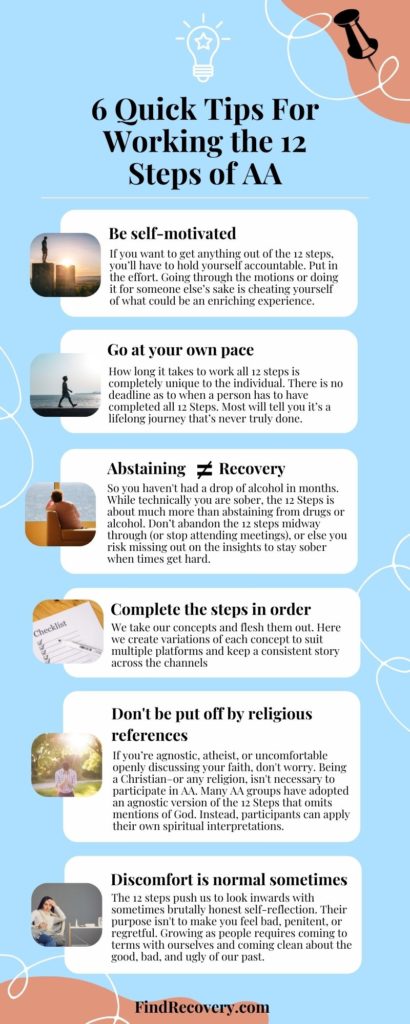
Quick Tips For Working the 12 Steps of AA [LIST]

For nearly a century, the 12 steps of AA have served as a foundation for recovering alcoholics. These dozen tenants have guided thousands through stages of admittance, self-awareness, gratitude, and forgiveness. But knowing the 12 steps is only part of the journey towards sobriety. To truly have these nuggets of wisdom be useful (and ultimately, living a sober and happy life) it’s crucial to understand how to work these steps and apply them to your everyday life. This easy and practical list of tips for working the 12 steps of AA will get you through it.

How To: Tips for Working the 12 Steps of AA

An inforgraphic breaking down 6 tips to keep in mind when entering AA’s 12-step program.
  1. Be self-motivated. Let’s clear one thing up: No one is going to follow up on you to make sure you’re giving each step its consideration and taking the lessons to heart. Not your sponsor, not chapter leadership, not other members. If you want to get anything out of the 12 steps, you’ll have to hold yourself accountable and really put in the effort. If you’re just going through the motions or doing it for someone else’s sake, you’re wasting your time and cheating yourself of what could be a very enriching experience. 
  2. Take your time and go at your own pace. How long it takes to work all 12 steps is completely unique to the individual. The lessons of some steps will come naturally to you. Others may be more challenging and take days, or even weeks, to fully comprehend and put into practice. This is perfectly okay. Rushing through them for the sake of “finishing” benefits no one–especially yourself. There is no deadline as to when a person has to have completed all 12 Steps and most will tell you it’s a lifelong journey that’s never truly done. 
  3. Abstaining from alcohol or drugs doesn’t mean you’re recovered. So you haven’t had a drop of alcohol in weeks, months, years. While technically you are sober, the 12 Steps is about much more than abstaining from drugs or alcohol. It’s about acknowledging the personal flaws that have led to this point and learning from them. Reckoning with your past as an addicted person, and using that as your motivation to remain abstinent. Don’t abandon the 12 steps midway through (or even worse, stop attending meetings), or else you risk missing out on the insights to stay sober when times get hard. 
  4. Complete the steps in order. Being stuck on a step can be frustrating. If you aren’t making the progress you would like, you may be tempted to move on and proceed to the other steps—the end goal is the same, right? The beauty of the 12 step program is that each step builds upon the other in a very deliberate progression. You might miss out on a valuable perspective required to properly work through those later steps you’re rushing towards. 
  5. Don’t be intimidated by religious references. If you’re agnostic, atheist, or uncomfortable openly discussing your faith, or anything in between, this tip is for you. Many individuals in recovery are put off or intimidated by the 12 Steps because of their frequent religious references. Bear in mind that Alcoholics Anonymous started as a Christian organization. It’s to be expected then, that those texts will carry some sort of religious mention. Do not feel that being a Christian–or any religion, is necessary to participate in AA. To better serve modern society, many AA groups have adopted a modified agnostic version of the 12 Steps that omits mentions of God and instead, calls on participants to apply their own spiritual interpretations.
  6. Prepare to be uncomfortable at times. There’s no sugar-coating it. The 12 steps push us to look inwards with sometimes brutally honest self-reflection. While many describe the feeling of completing these exercises as being freeing and exhilarating, in the moment, it can be disconcerting having to think about the not-so-great things we said, did, or thought, while under the control of drugs. For this reason it’s also very helpful to keep in mind that the purpose of the 12 steps is not to make you feel bad, penitent, or regretful. Growing as people requires coming to terms with ourselves and coming clean about the good, bad, and ugly of our past. 

Keep these tips in mind as you work through the 12 steps. Whether it’s your first time doing them, or your 100th, remembering these fundamentals will put you in the right frame of mind for getting the most out of these tried-and-true lessons. Find a 12 Step group meeting near you to begin your healing journey today.

Share our Infographic On Your Site

What to Expect at Your First AA Meeting
Walking into your first Alcoholics Anonymous meeting can feel like a big …
How AA Meetings Help People Stay Sober
Alcoholics Anonymous (AA) has become ubiquitous with the subject of addiction and …
Life Beyond the Steps: Alternative Support Systems for Recovery (SMART, Dharma, Refuge)
If you’ve tried A.A. but found it did not resonate with you, …

What Do AA Sponsors Do & Why You Need One

Those who have been through the 12 steps of AA know that sponsors can play a vital role in a recovering alcoholic or addict’s sobriety. Having a sponsor is one of those things people instantly associate with a 12-step recovery program. The role of a sponsor is very helpful, especially for beginners. But, what exactly do AA sponsors do? And is there an alternative figure you can choose instead? Read on to learn about the role of the sponsor and its importance in your recovery journey. 

What is an AA Sponsor?

Sponsorship is a relationship in which one person, the sponsor, helps another person, the sponsee, work a recovery program from alcoholism. It’s also called a “sponsor-sponsee relationship.”

A sponsor is someone who’s been through the problems and frustrations of drinking themselves. They completed the 12 steps and found recovery, sharing what they’ve discovered with others. The goal is to grow together and work as accountable figures in each other’s lives. 

The sponsor’s role is to help the sponsee through the twelve steps of Alcoholics Anonymous. This is usually a long-term commitment and can be lifelong if both parties agree. A sponsor isn’t an instructor, adviser, or therapist, but rather a fellow addict who understands what it’s like to be caught in the grip of alcoholism and has risen above it by using the twelve steps. The sponsor has no professional qualifications for this role, meaning if the sponsee fails to take responsibility for themselves, it isn’t the sponsor’s fault. 

The AA Sponsorship Book

A sponsor is an AA member who has been sober for some time and is committed to helping another alcoholic by providing advice and support during their recovery. They are your support system in the Big Book of Alcoholics Anonymous (the “Big Book”).

While there isn’t an AA sponsorship book that guides people through the role, sponsors are encouraged to follow the traditions in the Big Book. They can bring their experiences to the table for the sake of saving yours and their sobriety. They can only do that by ensuring they’re helping you while also staying active in their recovery. 

How to Ask Someone to be Your AA Sponsor

Everyone needs different qualities from their sponsor. Some recovering addicts respond well to “tough love,” while others prefer more understanding. When looking for a sponsor, think about these qualities:

  • Someone you can relate to
  • They have the kind of life you want to achieve in recovery, meaning you look up to them
  • They are honest and have integrity
  • They’ve been sober and are willing to share their experience with others
  • Someone with the time and disposition to be helpful and available

When you find that person, here are some ways to ask them to be your AA sponsor:

  • Do you already have a sponsee? If so, how many?
  • What motivated you to get sober?
  • Do you have any expectations from me?
  • Do you live far?
  • What motivates you to be a sponsor?
  • Would you do a trial sponsor-sponsee relationship to see if we’re a match?
  • Would you like to be my AA sponsor? 

When to Get a Sponsor?

Getting a sponsor is encouraged from the very beginning. Some people get a sponsor early on in the hopes they can help them navigate the steps. Others wait until they complete the 12-steps to seek an accountability buddy to help them recover. In the end, there’s no right or wrong timeline for seeking a sponsor. Much like in rehab, every sobriety journey is unique. 

Get the Help You Need

Whether you’re starting your recovery journey or you’ve been sober for some time, an AA sponsor is a key figure in your journey. Continue to attend meetings even after completing the steps, stay in touch with your sponsor, and don’t lose track of your therapist. 

Recovery from addiction is a lifelong journey that involves your active commitment. Don’t hesitate to seek help or reach out for help whenever you feel you might relapse. And, even if you do relapse, remember that it isn’t a failure but a setback. With the right support, you’ll get back on track in no time. 

Sources:

https://www.aa.org/questions-and-answers-sponsorship

What to Expect at Your First AA Meeting
Walking into your first Alcoholics Anonymous meeting can feel like a big …
How AA Meetings Help People Stay Sober
Alcoholics Anonymous (AA) has become ubiquitous with the subject of addiction and …
Life Beyond the Steps: Alternative Support Systems for Recovery (SMART, Dharma, Refuge)
If you’ve tried A.A. but found it did not resonate with you, …

Shame & Alcoholism: How to Cope With It

Shame is an automatic emotion that responds to a sense of failure. It’s a feeling many struggling with substance use disorders know a bit too well. Over time, shame disconnects individuals from the world around them, and it’s one of the things that fuels the secrecy and isolation commonly associated with alcoholism. In fact, different studies show that people who experience shame tend to experience more drinking-related consequences. After all, the tendency to use alcohol to reduce negative emotions is a very common coping mechanism. 

What Exactly Is Toxic Shame?

Toxic shame is a feeling of hopelessness. It can arise from others’ negative emotions, making you feel useless or not as good as others. Unlike guilt, shame makes you believe you’re not enough – a feeling alcoholics can recognize. While we all experience shame at some point in our lives, shame becomes toxic when the feeling stays with us. Toxic shame can result in two responses:

  • Withdrawal: You might feel inferior or not good enough to do something or be surrounded by others, so you want to withdraw and isolate yourself. 
  • Anger: Because you’re experiencing pain, it’s easy to feel anger against others and sometimes even yourself, particularly if your shame comes from your alcohol use disorder.

To cope with toxic shame, people turn to substance abuse, eating disorders, and self-harm. These unhealthy coping mechanisms provide an escape from emotional pain or the inability to face your true self. Other people develop perfectionist behaviors and have unrealistic expectations to avoid feeling or being shamed again. 

The Connection Between Shame and Addiction

Lots of people who struggle with alcohol use disorder have experienced trauma or dysfunction in their lives. Growing up with toxic shame can cause people to develop skewed images of themselves that can easily motivate them to seek comfort in substances. 

Unfortunately, the connection between shame and addiction creates a vicious cycle that can be tough to break. Studies show that shame could follow when people experience failure to meet role expectations due to their drinking habits. For example, an alcoholic can get into a public argument or miss work after a day of binge drinking. Such events can result in shame and can fuel more drinking as a coping mechanism to detach from the feelings of shame. 

This vicious cycle exacerbates anxiety and depression that makes addiction even worse to manage. Similar studies have proved the connection between shame and addiction. One study found that students who perceived themselves as drinking more than their peers experienced shame after drinking. In turn, it also increased drinking over time. This study shows that shame can be a trigger and a consequence of excessive drinking, at least for some people. 

How to Deal With Toxic Shame

It’s possible to overcome shame and alcoholism. Many alcohol addiction treatment programs focus on addressing feelings of shame and guilt. It’s also a matter of practicing self-compassion, self-awareness, and having patience. Here are some tips to overcome shame:

  • Become aware of how you talk to yourself and try not to react to it; write down your thoughts to help you become more self-aware of your sabotage.
  • Practice mindfulness and medication to help you observe your thoughts and learn how to react to shame from a more positive environment. 
  • Find support groups within the recovering alcoholics’ community to receive support and caring feedback about your recovery journey. 
  • Consider starting a journal to help you express your feelings without letting them affect you directly. 
  • Recognize when you’re feeling shame and consider a positive method of coping such as meditation, affirmations, or reaching out for help. 
  • It might be worth it for toxic shame to talk to a trusted therapist who can help you unwind previous trauma that could contribute to your shame and alcohol use disorder. 

Overcoming Shame In Addiction Recovery

Toxic shame is a prevalent relapse trigger. People in addiction recovery often struggle with feelings of shame, and that can hinder their progress. You must remember we all experience shame, guilt, and self-doubt. If you’re struggling with shame, seek help and speak up. Individual counseling or group therapy with an addiction specialist can help you cope and manage shame in recovery. 

Both therapy modalities will give you a safe space to dive deep into your experiences to help you identify the source of your toxic shame. Through different healing methods, you can work alongside a therapist and peers to find new ways to control these unhealthy thoughts and eventually learn the mechanisms and skills to prevent a relapse episode. 

Alcoholism in Marriage: How to Cope When You’re Married to an Alcoholic

Being married to an alcoholic or even a recovering alcoholic can understandably lead to feelings of stress and hopelessness. When alcoholism and marriage coincide, a lot happens among both parties and the family. As you might know, alcohol use disorder affects the entire family and suddenly changes the family dynamics. When you’re married to someone with a substance use disorder, you might feel lost and scared about your relationship’s future. Keep reading to learn how to cope when you’re married to an alcoholic and how to be a supportive partner.

Alcoholism and Marriage

Someone with an alcohol use disorder makes drinking their priority, pushing other people and other things to the side. It’s common for marriages with alcoholic
partners to get into physical altercations, struggle with financial difficulties, and place strain on all family members.

Estimates believe between 10% to 45% of marriages in the United States are alcoholic marriages. Over time, researchers have studied the effects of alcoholism in marriage and found that:

  • Alcoholics are by far less likely to marry than nonalcoholic
  • Alcoholics who get married often either do so earlier or later than nonalcoholic
  • Recovering alcoholics are likely to reduce their alcohol use once married
  • Alcoholics are more likely to get divorced than nonalcoholic

Alcohol abuse can contribute to marital conflict, infidelity, domestic violence, unplanned pregnancy, and financial instability. Not to mention, it places a layer of stress and psychological strain that can be burdensome for anyone.

How Alcoholism Affects the Family Dynamics

Alcoholism can increase rates of divorce by at least 20%. It also increases irrational actions, including domestic abuse. Alcoholism in marriage can also cause significant distress, anger, resentment, dysfunctional communication, and mental health strain.

Today, about 1 in every 8 children grow up in a home where a parent or caregiver abuses drugs or alcohol. Being around alcoholism can also affect how children function later in life. In the short term, children may develop indifferent or demanding behaviors. Long-term, children who grew up in alcoholic marriages can develop PTSD, anxiety, and depression. Children of addicts are more likely to develop substance use disorders when they grow up. They’re also three times more likely to be neglected physically and sexually abused.

When there’s a family unit, alcoholism significantly changes the family dynamics. First of all, nonalcoholic spouses might often blame themselves or try to control the problem by themselves. These effects will trigger a chain of reactions that can place a significant burden on any marriage.

Another interesting result of alcoholism in marriage is the dynamic of the enabler. The enabler figure often appears in families with small children. As nonalcoholic partners want their children to live in a happy and safe environment, they’re likely to make excuses and cover up the evidence of alcoholism to make the problem disappear. However, in reality, they’re enabling the alcoholic’s behavior and patterns.

Codependency is another common effect of having an alcoholic marriage. Once a partner becomes an enabler, they can become co-alcoholics by helping their loved one with their alcohol abuse without noticing. Codependency treatment is also available in rehab and can be highly effective.

Top Books On Alcoholism and Marriage to Consider

For alcoholic marriages, there are many books on alcoholism and marriage that can be helpful. These are some popular books on alcoholic marriages to consider:

Can a Marriage Survive Alcoholism?

Many marriages do survive alcoholism. The first step is to seek help and consider having an intervention. With an intervention, your loved one can hopefully recognize their need for help. In this case, it’s always best to come prepared and already have a treatment center selected. Many rehab centers will work with you in organizing the intervention. The idea is to have everything ready in case the addict accepts help.

But addiction affects everyone in the family. Since alcoholism often strains relationships, it’s important to incorporate couples counseling and family therapy as part of the treatment. Seeking help for your loved one, for yourself, and your family is important.

It’s also important to note that you’re not supposed to save anyone from addiction – it’s not your role., if ultimately you have to consider divorce, don’t blame yourself. Seek help from support groups like Al-Anon family groups, or consider speaking to an addiction counselor to find the support you need to focus on your mental health as well.

Sources:

https://www.ncbi.nlm.nih.gov/pmc/articles/PMC2700350/

https://psycnet.apa.org/record/1985-04356-001